
What is Feminizing Rhinoplasty?
Feminizing Rhinoplasty is a high-precision intervention within gender affirmation surgery. Unlike conventional rhinoplasty, this procedure focuses on modifying the bone and cartilaginous structures that typically present more robust or angular features toward a softer, thinner, and more defined morphology.
At our center in Zaragoza, we approach the nose as a key piece of the Facial Feminization Surgery (FFS) puzzle. We do not seek a “catalog nose,” but rather a structure that harmonizes with your forehead, cheekbones, and lips, eliminating heavy features to give way to a softer and more balanced expression.
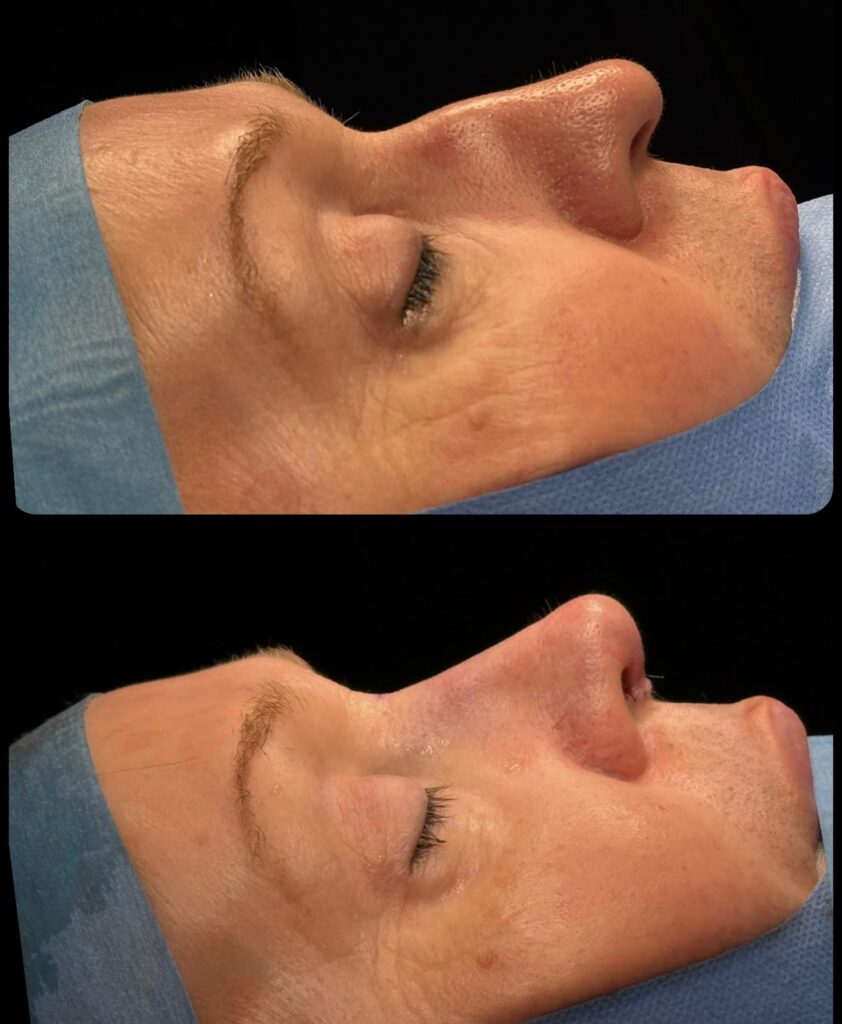
The process: Your Path to a Harmonious Profile
Facial Analysis
During the first consultation in Zaragoza, we use imaging technology to project the results and ensure that the new design fits your expectations and bone structure.
Precision Surgery
We often employ piezoelectric technology, which allows cutting bone with maximum precision without damaging soft tissues, drastically reducing bruising and postoperative pain.
Recovery Phase
During the first week you will wear a small protective splint. Although initial swelling disappears quickly, the nose is the tissue that takes the longest to show its definitive shape.
Personalized Follow-up
We conduct periodic reviews to monitor internal healing and ensure that respiratory function is impeccable along with the aesthetic change.
Ultrasonic Rhinoplasty: Precision without trauma
At Clínica San Clemente we use piezoelectric (ultrasonic) technology for our affirmation rhinoplasties. Unlike traditional techniques with chisel and hammer, this technology offers fundamental advantages:
- Respect for Soft Tissues: The device vibrates at a frequency that only cuts bone and hard cartilage, leaving blood vessels and skin intact.
- Zero Bruising: By not breaking capillaries, the appearance of bruising is minimal or nonexistent, allowing you to resume your social life much sooner.
- High-Definition Sculpting: It allows us to "polish" the bone millimeter by millimeter. This is vital for narrowing the nasal dorsum symmetrically and achieving that delicacy that characterizes the feminine face.
- Pain-free Postoperative Period: Being a much less invasive technique, swelling is reduced and the sensation of pain is limited to slight nasal pressure.
Frequently asked questions
At our clinic in Zaragoza, we not only address your medical concerns, but we also support you emotionally at every stage. Your safety and your identity are our priority.
How does it differ technically from common rhinoplasty?
While aesthetic rhinoplasty seeks to correct imperfections, feminizing rhinoplasty seeks to change the gender cue. This involves working specifically on the nasolabial angle (the inclination between the lip and nose) and on reducing the bony base to soften the transition with the forehead, features that tend to be wider and more pronounced in masculine structures.
Can it be performed together with other Facial Feminization procedures?
Yes, in fact it is most advisable. Rhinoplasty is usually combined with frontoplasty (forehead remodeling) or lip-lift (upper lip elevation). Performing these interventions together allows the surgeon to balance facial distances in a single surgical time, achieving superior harmony.
Will I lose my identity or characteristic features?
Our approach is natural feminization. The goal is for you to continue looking like yourself, but with the softness that testosterone concealed. We work on your own features so that the change is noticeable in terms of gender, but subtle in terms of “looking operated on.”
What is the actual pain and postoperative period like?
Thanks to the ultrasonic technique, pain is very moderate (similar to severe nasal congestion). The most bothersome aspect is usually the inability to breathe through the nose for the first 2-3 days. Most of our patients in Zaragoza resume their social life at 10-14 days with light makeup foundation.
Will the change in nasal structure affect my voice?
No. Rhinoplasty modifies the external structure and nasal valves, but does not intervene in the vocal cords or laryngeal resonance. Although the nasal cavity is a resonance chamber, standard surgical changes do not produce a perceptible alteration in voice timbre.

Let us support you


